Bankruptcy cost timeline: What filing solves — and what it quietly triggers
Bankruptcy is often described as a reset.
A number.
A filing date.
A before and after.
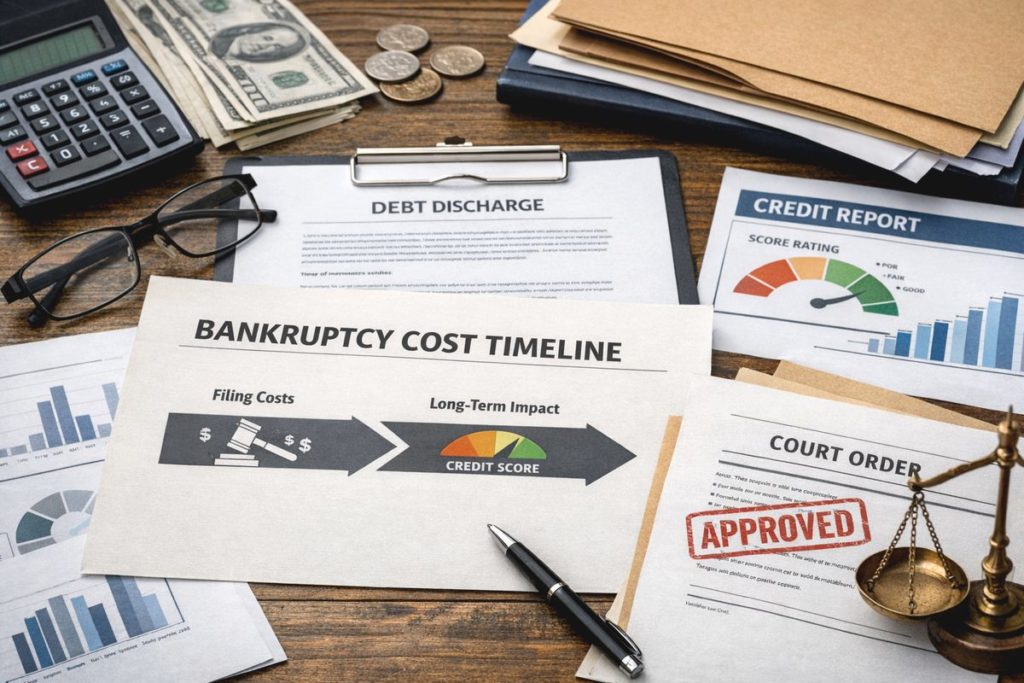
But a bankruptcy cost timeline is rarely just about court fees or attorney invoices. It’s a sequence of financial, behavioral, and systemic consequences that unfold at different speeds.
Some effects are immediate.
Some are delayed.
Some are invisible at first — and expensive later.
The decision to file is not only about eliminating current pressure. It is also about choosing a timeline of trade-offs.
This piece does not argue for or against filing. It examines what the timeline tends to look like — and where assumptions are often smoothed too early.
Who this is for
- Individuals comparing bankruptcy to structured repayment
- People trying to understand the long-term cost logic, not just filing fees
- Readers in the research phase who sense that the real cost may not be upfront
Who this is NOT for
- Readers seeking step-by-step filing instructions
- Those looking for a quick “yes or no” answer
- Anyone expecting a guaranteed financial outcome
The bankruptcy cost timeline is not one number
When people search for the cost of filing bankruptcy, they usually mean:
- Court fees
- Legal representation
- Administrative costs
These are visible. They are quoted. They feel finite.
But cost, in this context, operates in layers:
| Immediate layer | Extended layer |
|---|---|
| Court & attorney fees | Credit access limitations |
| Mandatory courses | Insurance pricing shifts |
| Document preparation | Rental & employment screening effects |
The first column is measurable.
The second column is contextual.
Decision marker: Are you evaluating a short-term cash outflow, or a multi-year financial repositioning?
Stage 1: The upfront cost of filing bankruptcy
The direct filing cost typically includes:
- Court filing fees
- Attorney fees (if representation is used)
- Required credit counseling and education courses
In many cases, this can range from several hundred to several thousand dollars, depending on jurisdiction and complexity.
But the number reflects a model:
relief through legal discharge.
It does not reflect what happens after discharge.
Research on consumer bankruptcy patterns suggests that while many filers experience immediate debt relief, the rebuilding phase varies widely based on income stability and access to credit markets.
The filing fee is the entry point. Not the endpoint.
Stage 2: The quiet financial consequences of bankruptcy
This is where the conversation shifts.
The financial consequences of bankruptcy are not penalties. They are systemic reactions.
Credit reports reflect the filing for years.
Lenders reprice risk.
Landlords evaluate applications differently.
Insurance companies may use credit-based scoring models.
This doesn’t mean financial life stops.
It means pricing logic changes.
Named uncertainty: behavioral and pricing uncertainty.
You cannot know in advance how each institution will interpret your profile. The system recalculates risk continuously.
And that recalculation has a cost — sometimes visible, sometimes embedded in higher rates or deposits.
Stage 3: Bankruptcy fees over time — the rebuilding phase
There is a common assumption:
Filing removes debt → credit score drops → rebuild → everything stabilizes.
Reality is less linear.
During rebuilding, individuals often face:
- Secured credit requirements
- Higher interest rates
- Limited borrowing options
- Larger security deposits
These are not labeled as “bankruptcy fees,” but they function like them.
The phrase bankruptcy fees over time captures something broader than invoices. It includes the premium paid for re-entry into credit systems.
Editorial thesis: Bankruptcy cost is a time-distributed pricing adjustment, not just a legal expense.
The longer the rebuilding phase, the more the cost shifts from legal to behavioral.
Stage 4: Life after bankruptcy cost — structural trade-offs
“Life after bankruptcy cost” is rarely discussed in court documents.
It appears in:
- Housing flexibility
- Entrepreneurial financing
- Mortgage qualification timing
- Business partnerships
- Psychological risk tolerance
Studies on financial recovery suggest that the emotional relief after discharge can coexist with prolonged credit constraints. The tension is real: psychological reset vs structural limitation.
This is not contradiction. It is timeline divergence.
Decision marker: Are you optimizing for emotional stabilization or long-term financial leverage?
Sometimes they align. Sometimes they do not.
What bankruptcy actually costs long term
The long-tail question — what bankruptcy actually costs long term — depends on the framework used to measure cost.
If cost = legal expense → limited.
If cost = multi-year credit repositioning → extended.
If cost = opportunity timing → situational.
For example:
- Delayed mortgage access
- Reduced financing options for business expansion
- Higher insurance pricing bands
None of these are guaranteed.
All of them are probabilistic.
This is a systems decision, not a single transaction.
Hidden costs after filing bankruptcy
The phrase hidden costs after filing bankruptcy often implies deception.
That framing misses the point.
Most costs are not hidden. They are simply relocated in time.
Instead of paying creditors, you may pay in:
- Credit premiums
- Access constraints
- Slower asset accumulation
- Reputation recalibration in financial databases
Uncertainty remains around how quickly an individual’s income trajectory improves. Income stability can compress the timeline. Instability can extend it.
The timeline is elastic.
Two models of decision logic
| Short-term pressure model | Long-term positioning model |
|---|---|
| Focus: immediate debt relief | Focus: multi-year credit strategy |
| Primary metric: monthly cash flow | Primary metric: future access & leverage |
| Filing seen as solution | Filing seen as reset with trade-offs |
Neither model is inherently superior.
They answer different questions.
FAQ
Does bankruptcy eliminate all financial consequences?
It addresses qualifying debts legally. It does not remove systemic risk recalculations by lenders or insurers.
How long does bankruptcy affect credit?
Credit reports typically reflect filings for multiple years. The financial impact, however, depends on income stability and borrowing behavior.
Are the long-term costs predictable?
Not precisely. Pricing adjustments and access limitations vary by institution and market conditions.
Is bankruptcy always more expensive in the long term?
Cost depends on comparison. Against continued compounding debt, it may reduce total exposure. Against uninterrupted credit growth, it may extend rebuilding.
What happens after the next step
If you move from research to consultation, the conversation usually shifts from “Should I file?” to:
- What timeline am I entering?
- Which model of recovery am I assuming?
- What risks am I transferring — and which am I retaining?
The answer is rarely a single number.
It is a projection built on income expectations, credit behavior, and tolerance for temporary constraint.
And projections carry uncertainty.
Editorial hero
Bankruptcy is not a number on a form.
It is a sequence of financial recalibrations unfolding over time.
The quote reflects a decision framework, not just paperwork.
Final reflection
A bankruptcy cost timeline begins with a filing fee.
It continues through credit repricing.
It evolves into access negotiation.
It settles — eventually — into a new baseline.
But that baseline depends on how the intervening years unfold.
Which is why the real question is not “What does bankruptcy cost?”
It is:
What kind of timeline am I willing to enter — and how do I value relief versus repositioning?
That answer rarely arrives in a single search.
Editorial team at BeautyHealth.top
Research-based consumer guides