
Online degree cost vs ROI over 10 years: When the numbers stop making sense
An online degree is often presented as a cleaner equation.
Lower tuition.
Flexible schedule.
No relocation.
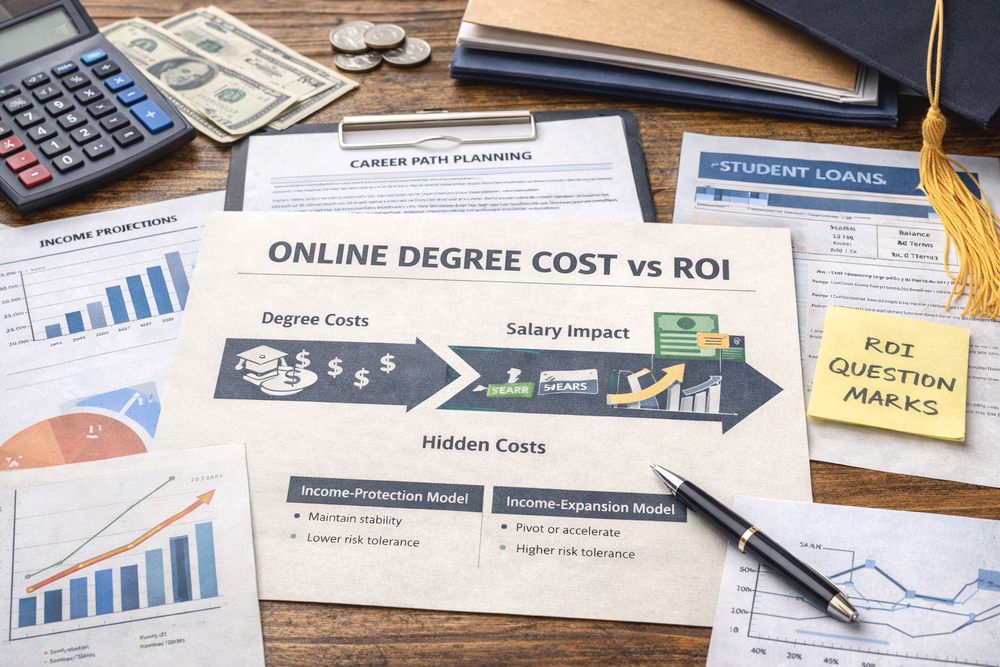
And then the central question: online degree cost vs ROI — does it pay off?
But return on investment in education rarely behaves like a spreadsheet cell. Over ten years, the numbers stop being static and start interacting with time, career pauses, wage volatility, and debt structure.
The real comparison is not tuition vs salary.
It is timing vs trajectory.
Who this is for
- Professionals considering an online degree mid-career
- Younger students comparing traditional vs remote education models
- Anyone trying to evaluate online degree return on investment beyond marketing claims
Who this is NOT for
- Readers seeking a list of “top programs”
- Those looking for enrollment advice
- Anyone expecting a guaranteed salary outcome
Online degree cost vs ROI is not a tuition question
When people calculate the cost of online degree over time, they usually start with:
- Tuition per credit
- Technology fees
- Books and materials
This is the visible layer.
But the 10-year timeline includes:
- Opportunity cost of time
- Reduced working hours during study
- Delayed promotions
- Interest on student debt
- Career redirection risk
The cost is not only financial outflow. It is how your earning curve bends during those years.
Decision marker: Are you measuring expense reduction or income acceleration?
These are different frameworks.
Stage 1: The immediate financial model
In short-term logic, an online degree may look efficient:
| Short-term view | Extended 10-year view |
|---|---|
| Lower tuition than campus programs | Salary growth depends on field demand |
| No relocation cost | Career breaks affect compounding raises |
| Flexible scheduling | Burnout risk during dual work-study load |
The first column is transactional.
The second is systemic.
Research on adult learners suggests completion rates and post-degree earnings vary significantly by field, not format. The delivery mode is rarely the dominant variable.
That complicates the ROI equation.
Stage 2: Online degree return on investment and salary timing
The phrase online degree long term salary impact assumes a linear raise.
In reality, income growth behaves in waves:
- Entry salary shift
- Skill-based negotiation phase
- Market cycle adjustments
- Industry disruption
An online MBA in a growing industry may compress the payback period.
The same credential in a saturated sector may extend it.
This introduces a named uncertainty: market-cycle uncertainty.
The ROI model changes depending on whether you assume stable industry growth or structural change.
Editorial thesis: ROI reflects a belief about the future labor market, not just tuition math.
Stage 3: When an online degree does not pay off
The long-tail search — when an online degree does not pay off — rarely has a clean answer.
It may not pay off when:
- The credential does not alter job eligibility
- Industry demand declines during study
- The degree substitutes for experience rather than complements it
- Debt repayment restricts career flexibility
This is not a judgment about education quality.
It is about alignment between credential and labor demand.
Studies on graduate earnings consistently show dispersion within the same degree category. Field selection and geographic mobility often influence earnings more than delivery format.
The degree is a signal.
The market decides how strongly to interpret it.
Stage 4: Hidden costs of online education over time
The phrase hidden costs of online education over time often implies surprise fees.
But the deeper hidden costs are temporal:
- Slower career experimentation
- Reduced entrepreneurial risk tolerance while servicing debt
- Opportunity cost of years spent in academic focus
- Networking limitations in certain sectors
None of these are guaranteed disadvantages.
They are trade-offs.
Online education provides flexibility.
Flexibility can also dilute immersion.
The ROI shifts depending on how you use that flexibility.
Decision marker: Are you preserving income stability, or attempting upward mobility?
These motivations produce different cost structures.
The 10-year horizon problem
A ten-year projection assumes:
- Stable health
- Stable industry
- Predictable economic cycles
- Consistent motivation
These assumptions are rarely explicit in ROI calculators.
The financial break-even point — often cited as 5–8 years in various analyses — reflects an average model. It does not account for career pauses, caregiving responsibilities, or macroeconomic downturns.
Named uncertainty: life-event uncertainty.
Over a decade, personal events interact with financial projections.
The ROI equation stretches.
Is online degree worth it financially?
The question is online degree worth it financially cannot be answered without defining “worth.”
If worth = salary increase → depends on field and timing.
If worth = career mobility → depends on network and industry.
If worth = intellectual capital → depends on application.
Online degree cost vs ROI is not a binary outcome.
It is a strategic bet on:
- Future wage growth
- Personal discipline
- Market resilience
And bets carry probability, not certainty.
Comparing decision models
| Income-protection model | Income-expansion model |
|---|---|
| Goal: maintain current career stability | Goal: pivot or accelerate |
| Lower risk tolerance | Higher risk tolerance |
| ROI measured conservatively | ROI measured aggressively |
Neither model is wrong.
They simply assume different futures.
FAQ
Does an online degree typically have lower ROI than traditional degrees?
Format alone does not determine ROI. Field demand, reputation, and labor conditions tend to influence salary outcomes more significantly.
How long does it take to break even?
Break-even estimates vary widely. They depend on debt load, salary growth, and economic cycles rather than a universal timeline.
Are online degrees respected equally?
Perception varies by industry. In some sectors, demonstrated skills outweigh delivery format.
What is the biggest uncertainty in ROI projections?
Long-term labor market shifts and personal life events tend to introduce the largest variance.
What happens after the next step
If you move from research to enrollment consideration, the conversation shifts:
- What income curve am I assuming?
- What debt tolerance fits my risk model?
- How flexible is my industry over the next decade?
The degree itself is not the full investment.
Time is.
And time compounds differently depending on market direction.
Editorial hero
An online degree is not a tuition invoice.
It is a ten-year positioning strategy shaped by labor demand, debt structure, and personal trajectory.
The spreadsheet reflects assumptions — not outcomes.
Final reflection
The debate around online degree cost vs ROI often simplifies into a number.
But over ten years, the equation absorbs salary cycles, life events, and behavioral trade-offs.
The cost of online degree over time is visible.
The return unfolds unevenly.
Which raises a quieter question:
Are you investing in a credential — or in a future version of your earning curve?
That distinction tends to matter more than the tuition line.
Editorial team at BeautyHealth.top
Research-based consumer guides