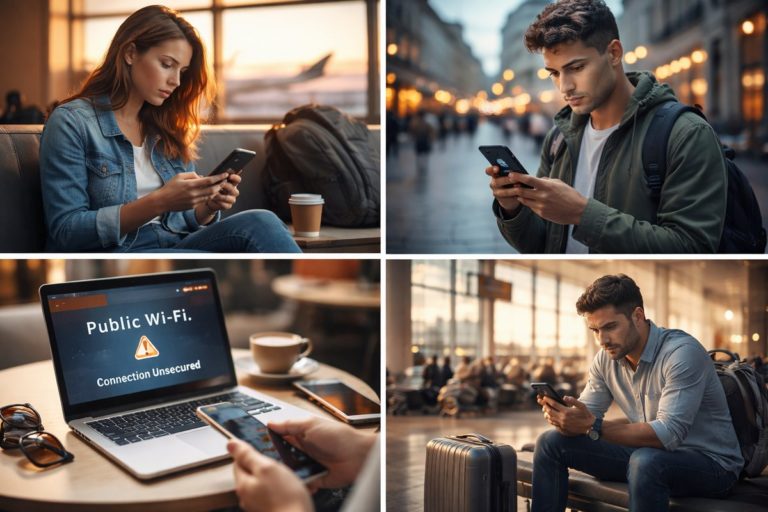
Best Ways to Stay Connected When Traveling — What Actually Works Outside Your Home Network
Staying connected while traveling used to be a background detail.
Today, it quietly shapes the entire trip.

Navigation.
Payments.
Work messages.
Hotel check-ins.
Unexpected changes.
Connectivity is no longer a convenience — it’s part of how travelers move, decide, and feel in control.
But not every connection method works the same once you cross borders.
And some options add friction exactly when you expect them to simplify things.
Let’s slow this down and look at the best ways to stay connected when traveling, without assuming there’s a single “right” solution.
Why staying connected when traveling is harder than it looks
At home, connectivity is invisible.
Abroad, it becomes a system with weak points.
Different countries mean:
- different mobile standards,
- different roaming rules,
- different coverage reliability,
- and very different pricing logic.
What feels “normal” at home often breaks quietly the moment you land.
According to population-level travel behavior research, connectivity issues rank among the top hidden stressors during international trips — not because of total disconnection, but because of unpredictability.
That unpredictability is what travelers are actually trying to solve.
Public Wi-Fi: convenient, fragile, and situational
Public Wi-Fi is usually the first fallback.
Airports.
Hotels.
Cafés.
It works — until it doesn’t.
Where public Wi-Fi helps
- Short sessions
- Low-risk browsing
- Non-urgent communication
Where it breaks down
- unstable speed,
- login friction,
- security concerns,
- inconsistent availability outside city centers.
Public Wi-Fi reduces cost, but increases uncertainty.
For some trips, that tradeoff is acceptable. For others, it isn’t.
Local SIM cards and eSIMs: flexibility with limits
Buying a local SIM or activating an eSIM feels like a smart move — and often is.
Strengths
- local pricing,
- decent coverage,
- direct mobile access.
Hidden friction
- language barriers during purchase,
- registration requirements,
- compatibility issues,
- switching between numbers.
For travelers moving through multiple countries, repeated setup becomes its own task.
Research suggests that repeated “micro-frictions” — small setup steps repeated often — significantly increase perceived travel stress, even when each step is simple.
Portable Wi-Fi solutions: predictability over improvisation
This is where portable connectivity devices enter the picture.
Instead of adapting to each country, the traveler carries a consistent connection layer.
Why predictability matters
- one setup,
- one network behavior,
- fewer decisions mid-trip.
For people working remotely, managing bookings, or coordinating logistics, predictability often matters more than peak speed.
Portable Wi-Fi doesn’t replace local networks — it abstracts them.
And abstraction reduces cognitive load.
Best ways to stay connected when traveling: a comparison
| Option | Strength | Limitation |
|---|---|---|
| Public Wi-Fi | Free or low cost | Unstable, insecure |
| Local SIM / eSIM | Local performance | Setup friction |
| Phone roaming | Familiar | Cost volatility |
| Portable Wi-Fi | Predictable access | Extra device |
There’s no universal best option.
Only the option that fits how you travel.
When connectivity becomes a decision-support problem
Connectivity tools don’t just provide internet.
They shape decisions.
Can I reroute now?
Can I work from here?
Can I rely on maps off the highway?
The best ways to stay connected when traveling are the ones that reduce decision pressure, not just provide signal.
Studies on cognitive load in unfamiliar environments show that reliable background systems — like navigation or connectivity — free mental bandwidth for situational awareness.
That’s an invisible benefit travelers often underestimate.
Who this is for
- Travelers visiting multiple countries on one trip
- Remote workers and digital nomads
- People who depend on navigation, bookings, or messaging in real time
- Travelers who value predictability over improvisation
Who this is NOT for
- Short trips with guaranteed hotel Wi-Fi
- Travelers who intentionally disconnect
- Situations where offline access is sufficient
- Trips where connectivity is non-essential
What happens after you choose your connection method
At first, any solution feels fine.
The difference shows up later.
When plans change.
When coverage drops.
When something unexpected happens.
That’s when travelers realize whether their setup supports decisions — or complicates them.
The next step isn’t “more speed.”
It’s fewer surprises.
FAQ
Is public Wi-Fi enough for international travel?
Sometimes. But reliability and security vary widely.
Are local SIMs always cheaper?
Often, but setup time and compatibility matter.
Do portable Wi-Fi options work everywhere?
Coverage depends on regions, but predictability is usually higher than ad-hoc solutions.
Can one solution cover an entire multi-country trip?
Some can. The key is consistency, not maximum performance.
Staying connected while traveling isn’t about constant access.
It’s about knowing what will work when you need it.
The best ways to stay connected when traveling don’t remove uncertainty completely —
they reduce it enough to keep decisions simple.
And simplicity is what travelers remember most.
Editorial team at BeautyHealth.top
Research-based consumer guides