
Dental Implants vs. Dentures: How the Choice Really Feels in Everyday Life
Tooth loss isn’t just a cosmetic issue. It quietly changes how you eat, speak, and even how comfortable you feel laughing in public. When people start comparing dentures and dental implants, the discussion often sounds technical — materials, prices, procedures.
In reality, the decision is much more human.
It’s about daily comfort, long-term confidence, and how much dental work you’re willing to live with over the years.
Let’s break this down in a way that actually helps you decide.
Dentures: What Living With Them Is Like
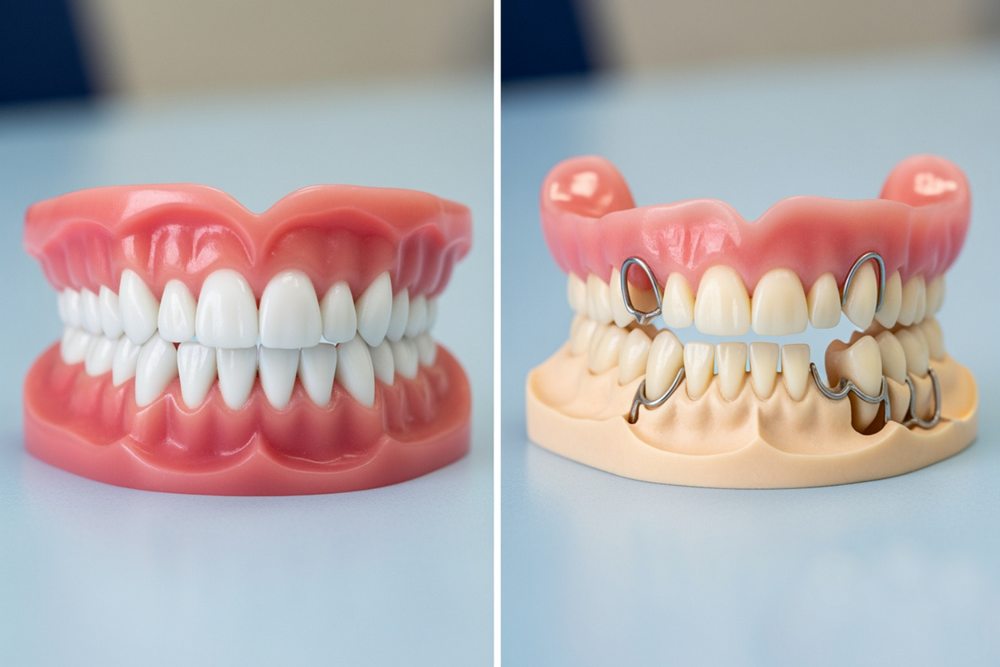
Dentures are removable prosthetic teeth, usually made from acrylic or porcelain. They rest on the gums and are shaped to replace several missing teeth — or all of them.
Some people adapt to dentures quickly. Others never quite forget they’re there.
What tends to work well
- Lower upfront cost compared to implants
- No implant surgery required
- Easy to remove for cleaning
- Faster solution when many teeth are missing
What people don’t always expect
- Movement while eating or speaking can happen over time
- Daily cleaning routines become non-negotiable
- Gums and jawbone continue to change shape, which often means refitting or replacing dentures every few years
- Bone loss in the jaw can subtly change facial structure over time
Many denture wearers describe them as “good enough,” but not invisible. You’re often aware of them — especially during meals or social situations.
Dental Implants: A Different Philosophy
Dental implants replace not just the tooth, but the root. A titanium or zirconia post is placed into the jawbone, where it integrates and becomes part of the structure supporting your bite.
That difference changes almost everything.
Why many patients choose implants
- Fixed in place — no slipping, no removal
- Chewing feels closer to natural teeth
- Helps preserve jawbone and facial support
- Long lifespan with proper care
- No nightly soaking, adhesives, or removal
What requires consideration
- Surgical placement and healing time
- Higher upfront cost
- Not everyone is a candidate without bone support or medical clearance
For many people, implants feel less like a “dental appliance” and more like getting part of their mouth back.
Cost: Short-Term vs Long-Term Thinking
Dentures usually win on initial price. A full set can cost significantly less upfront than implants.
Implants, on the other hand, ask more at the beginning — but often less over decades.
Dentures typically need:
- Periodic relining
- Replacement every 5–7 years
- Ongoing adjustments as bone changes
Implants are often placed once and maintained like natural teeth.
According to population data, long-term satisfaction rates tend to be higher among implant patients, largely due to stability and chewing comfort — factors that don’t always show up on a price list.
Safety and Recovery: What Really Matters
Dentures avoid implant surgery, which makes them appealing to people who want the least invasive option.
Implant surgery is a medical procedure, but modern techniques have made it far more predictable than many people expect. For suitable candidates, recovery is usually controlled and planned — not emergency-based.
Studies have shown that implant success rates remain high even in older adults, provided overall health and bone conditions are assessed carefully.
So the question isn’t “Is surgery risky?”
It’s “Is one procedure now preferable to ongoing adjustments later?”
How People Often Decide (Quietly)
When patients talk honestly, the decision usually comes down to one of these thoughts:
- “I want the simplest solution right now.” → Dentures
- “I don’t want to think about my teeth every day.” → Implants
- “I’m okay maintaining something removable.” → Dentures
- “I want this to feel permanent.” → Implants
Neither option is wrong. They simply serve different priorities.
A Decision Worth Taking Time With
Dental implants and dentures solve the same problem — but in very different ways.
One is adaptable and removable.
The other is fixed and structural.
If you’re weighing these options, the most important step isn’t choosing quickly — it’s understanding how each solution fits into your daily life, health situation, and long-term expectations.
And if there’s still a sense of uncertainty after reading this?
That’s normal. The best decisions usually take a little time to settle.