Is an online MBA worth it?
People search “Is an online MBA worth it?” when something in their career stops moving the way it used to. Growth slows, responsibilities increase, expectations rise — but the next step isn’t obvious. The real question usually isn’t about the degree itself. It’s about whether this investment will change the trajectory, or simply add another line to the résumé.
An online MBA is neither a shortcut nor a dead end. It’s a tool — and like any tool, its value depends on where and how it’s used.

What an online MBA actually gives you
At a practical level, an online MBA offers structured exposure to finance, strategy, operations, and management thinking, plus a credential that signals business literacy. What it doesn’t do is create authority or guarantee a career shift. Those outcomes depend on how clearly the degree connects to your existing experience and next role.
Research suggests that employers evaluate online MBAs less by delivery format and more by context — the institution, the candidate’s background, and how coherently the degree fits into their career story. In other words, misalignment matters more than “online” ever did.
When an online MBA tends to make sense
It usually pays off when you’re already moving forward, but informally. You may be managing people, owning results, or participating in decisions without the formal business grounding to support that role. In that case, the MBA doesn’t create momentum — it stabilizes it.
It also works when the goal is fluency rather than reinvention. Professionals from technical, operational, or specialist backgrounds often use an MBA to understand how decisions are made above their level, not to change industries entirely. Flexibility matters too: if stepping away for a full-time program isn’t realistic, the real comparison is online MBA versus no MBA at all.
When the value is limited
An online MBA is less likely to be worth it if you expect the credential alone to unlock opportunities, if your career direction is still unclear, or if networking is your primary motivation. Online programs can offer connections, but they rarely replace the signaling power of elite in-person networks. In these cases, the degree may feel productive without being decisive.
Cost beyond tuition
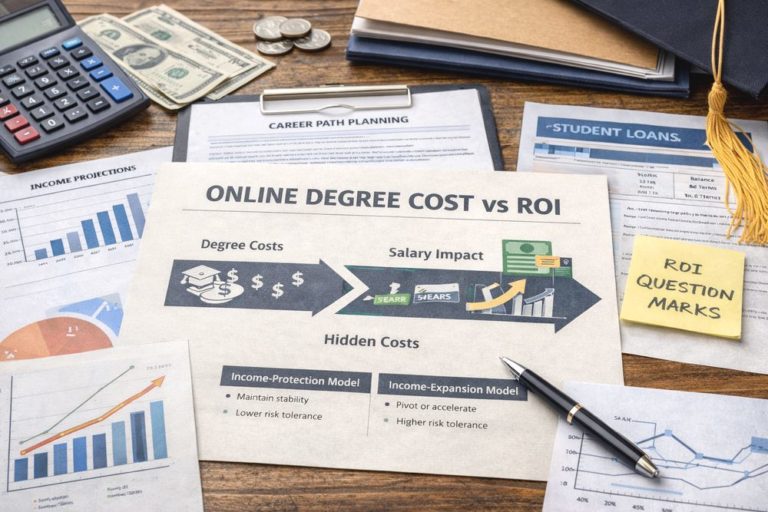
Tuition is only part of the equation. Time, mental load, and opportunity cost matter just as much. Studying while working preserves income, but it also stretches attention. The question becomes whether the skills you gain will be applied quickly enough to justify that strain.
So how do you decide?
If you’re asking is an online MBA worth it, the next step isn’t more reading — it’s clarity. Where are you trying to move next? What gap is actually holding you back? And is a structured business education the cleanest way to close it?
Until those answers are clear, the degree will always feel uncertain.
Who this is for
This guide is for professionals already on an upward path who need structure, credibility, or business fluency to keep moving. It’s not for those looking for a guaranteed pivot, instant seniority, or a substitute for direction.
Micro-FAQ
Is an online MBA respected? Often yes — when the institution and career context make sense together.
Will it increase salary? Sometimes, indirectly. Outcomes depend on role changes, not the degree alone.
Is it better than on-campus? It’s different. The right choice depends on constraints, not prestige alone.
If you’re still unsure, that’s not a failure to decide. It’s usually a sign that one more variable — timing, role, or expectation — needs to be clarified before committing.
Editorial team at BeautyHealth.top
Research-based consumer guides