
Charging costs at home vs public: what the numbers don’t show — and why the decision isn’t only about price
Charging an electric car seems simple on the surface.
You plug in.
You pay.
You drive.
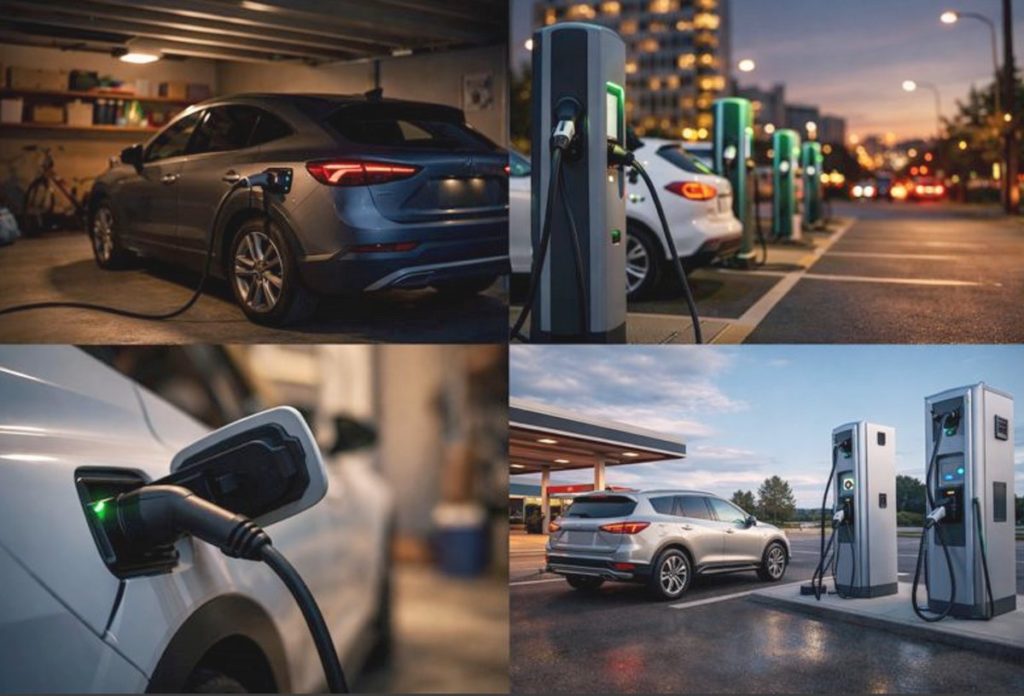
But the moment people start comparing charging costs at home vs public, something shifts.
Because this question rarely means “How much is electricity?”
It usually means:
“Am I making the right long-term decision?”
“Will this become inconvenient later?”
“What am I not seeing yet?”
So instead of rushing to a cents-per-kWh comparison, let’s slow this down.
Charging costs at home vs public: why the price gap exists in the first place
On paper, home charging almost always looks cheaper.
And in many cases, it is.
But that gap exists for reasons that aren’t obvious at first glance.
Public charging prices don’t just cover electricity.
They include:
– infrastructure installation and maintenance
– grid upgrades
– location rent
– payment systems
– peak-hour demand risk
– idle time management
Home charging, by contrast, uses infrastructure you already own — or amortize quietly over time.
That difference shapes the numbers long before you ever see a bill.
This is where most comparisons stop.
And that’s exactly where they become misleading.
The hidden math of home charging costs
At home, charging costs usually feel “invisible.”
You don’t swipe a card.
You don’t approve a transaction.
The car is just… ready in the morning.
But the cost is still there — just distributed.
Typical elements that shape home charging cost:
– residential electricity rate
– time-of-use pricing
– charger installation (one-time)
– grid stability in your area
– charging habits (overnight vs peak hours)
Studies analyzing residential EV charging patterns suggest that overnight charging during off-peak hours accounts for the lowest long-term cost per mile, not because electricity is cheaper — but because demand volatility is lower.
That distinction matters.
Public charging costs: what you’re actually paying for
Public charging feels more expensive for a reason.
You’re paying for availability, not just energy.
Public chargers solve problems home charging can’t:
– long-distance travel
– apartment living
– emergency top-ups
– unpredictable schedules
But availability has a premium.
Public charging costs are shaped by:
– charger type (Level 2 vs DC fast)
– location demand
– time-based pricing
– session fees
– idle penalties
Population-level usage data shows that drivers relying primarily on public fast charging often pay significantly more per mile, but also gain flexibility that can’t be priced purely in currency.
This is where the comparison stops being purely financial.
Charging costs at home vs public: side-by-side comparison
| Factor | Home Charging | Public Charging |
|---|---|---|
| Cost per kWh | Lower on average | Higher, variable |
| Price stability | Predictable | Volatile |
| Convenience | High (daily use) | Situational |
| Speed | Slower | Often faster |
| Infrastructure cost | Upfront | Included |
| Flexibility | Limited by location | High |
| Long-term control | Strong | Weak |
This table looks decisive.
It isn’t.
Because real decisions don’t happen in tables.
Why charging cost comparisons often fail in real life
Here’s what people rarely say out loud.
Charging decisions change with life.
A new job.
A move.
A different commute.
A second car.
People who plan based solely on today’s charging cost often feel friction later — not because they were wrong, but because the question changed.
Research on EV ownership patterns shows that mixed charging strategies (home + occasional public) lead to higher satisfaction than exclusive reliance on either option.
Not cheaper.
More sustainable psychologically.
That distinction is subtle — and easy to miss.
When home charging isn’t the cheaper option anymore
There are real cases where home charging loses its advantage:
– high residential electricity rates
– lack of off-peak pricing
– expensive electrical upgrades
– limited parking access
– shared meters
In these scenarios, public charging — especially slower community chargers — can quietly become competitive.
This doesn’t show up in generic calculators.
You only notice it months later.
Who this is for
This breakdown is for you if:
– you’re considering your first EV
– you’re deciding between home charger installation and public reliance
– you’re trying to understand long-term ownership costs
– you want clarity without marketing promises
Who this is NOT for
This is not for you if:
– you’re looking for a single “cheapest” answer
– you expect fixed prices over time
– you want guarantees about future electricity rates
– you’re optimizing for one month instead of several years
A quieter question hiding behind charging costs
Most people aren’t really asking about money.
They’re asking:
“Will this fit my life?”
Charging costs are just the proxy.
And that’s why the best decision often isn’t purely home or public — but knowing when each one works in your favor.
FAQ
Is home charging always cheaper than public charging?
Not always. It depends on local electricity rates, installation costs, and how often you rely on fast charging.
Are fast chargers always the most expensive option?
They usually cost more per session, but can reduce opportunity cost during travel.
Can I rely only on public charging long-term?
Some people do, but satisfaction tends to drop without predictable access.
Do charging costs change over time?
Yes. Pricing models, demand, and grid policies evolve.
What happens after this decision
Choosing between home and public charging doesn’t lock you in forever.
Most EV owners adjust their strategy within the first year — quietly, based on lived experience.
The key is not to optimize for the first month.
It’s to stay adaptable.
And that’s a different kind of savings.
Editorial team at BeautyHealth.top
Research-based consumer guides