Future Technologies Already Changing the World
Technology is no longer something reserved for science fiction. Many innovations that once seemed impossible are already part of everyday life, while others are moving rapidly from laboratories into real-world use. Smartphones, smart homes, digital payments, and immersive digital experiences have become normal within just one generation. What comes next is even more transformative.
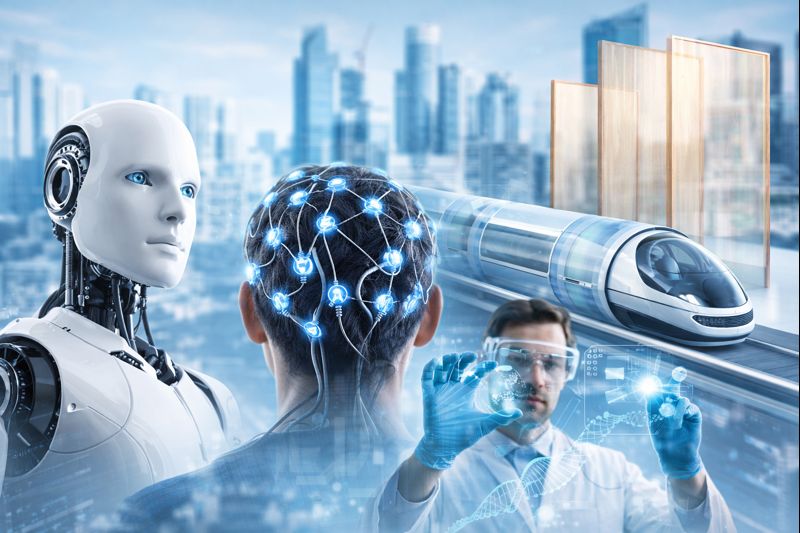
Experts believe that over the next few decades, technology will reshape how we live, work, travel, heal, and consume energy. Some of these changes are already visible today, while others are in advanced development stages.
Below are key future technologies that are already influencing the world — and will shape the decades ahead.
Augmented and Mixed Reality (AR & MR)
Augmented reality overlays digital elements onto the real world, while mixed reality allows users to interact with virtual objects as if they were physically present. Today, AR is widely used in mobile apps, navigation systems, education, and retail.
In transport and safety, AR systems highlight pedestrians, obstacles, and road signs in poor visibility conditions. In education and medicine, MR devices such as smart glasses help students visualize complex procedures and practice skills in realistic environments.
Virtual Reality (VR)
Virtual reality creates fully immersive digital environments. Beyond gaming and entertainment, VR is now used for professional training, virtual tourism, education, and medical rehabilitation.
Large companies already use VR simulations to train staff safely and efficiently. In healthcare, VR-based programs help patients recover motor and cognitive functions after strokes or spinal injuries by stimulating neural activity through guided virtual exercises.
Internet of Things (IoT)
The Internet of Things connects devices so they can exchange data automatically without human intervention. Smart meters, industrial sensors, logistics tracking systems, and home automation platforms all rely on IoT technology.
In daily life, IoT enables smart homes that manage energy use, security, heating, and lighting automatically. In agriculture, logistics, and manufacturing, connected systems help optimize production, reduce waste, and respond to demand in real time.
3D Printing
3D printing has moved far beyond prototyping. Today, it is used to manufacture tools, machine parts, medical implants, and even human tissues.
In medicine, researchers can already print skin, bone implants, and cartilage. The long-term goal is the creation of fully functional organs for transplantation. In construction and manufacturing, 3D printing reduces costs, shortens production time, and enables highly customized designs.
Wireless Energy Transfer
Wireless charging is no longer limited to smartphones. Researchers are developing systems that can power devices through radio waves, Wi-Fi signals, and electromagnetic fields.
The long-term vision includes supplying electricity to remote regions without cables and charging devices continuously without batteries. Prototype battery-free devices already exist, pointing toward a future of seamless energy access.
Robotics
Robots are becoming everyday assistants in factories, hospitals, warehouses, and homes. From robotic vacuum cleaners to surgical robots and warehouse automation, machines increasingly handle repetitive, dangerous, or precision tasks.
In the future, robots will play an even larger role in healthcare, disaster response, agriculture, and elderly care, working alongside humans rather than replacing them entirely.
Smart Cities
Smart city technologies integrate transportation, utilities, healthcare, waste management, and public services into connected digital systems. This allows cities to reduce congestion, improve safety, manage resources efficiently, and respond quickly to emergencies.
Smart city initiatives are already active in parts of Europe, Asia, and North America, using real-time data to improve quality of life for residents.
Artificial Intelligence
Artificial intelligence is rapidly evolving from basic automation to advanced systems capable of learning, reasoning, and understanding human behavior. AI is already used in healthcare diagnostics, finance, customer service, cybersecurity, and logistics.
Future AI systems are expected to understand emotions, analyze complex environments, and support decision-making across industries. Rather than replacing humans, AI is increasingly designed to enhance human capabilities.
Future Technologies in Construction
Innovations in construction aim to make buildings more sustainable, efficient, and resilient.
- Transparent wood offers strength, insulation, and light transmission.
- Smart glass adjusts transparency electronically, reducing energy consumption.
- Energy-storing bricks can temporarily store electricity.
- Self-healing concrete repairs cracks automatically using biological processes.
These materials could redefine architecture and urban development.
Medical Technologies of the Future
Healthcare innovation is accelerating rapidly.
- Smart glasses assist vision, monitor health indicators, and support diagnostics.
- Digital human twins allow doctors to monitor patient health virtually.
- Gene editing (CRISPR) offers treatment for genetic diseases and age-related conditions.
- mRNA vaccines show promise for HIV, malaria, and future pandemics.
Preventive and personalized medicine is becoming a realistic goal.
Food and Sustainability Technologies
To support a growing global population, new food technologies are emerging:
- 3D-printed food
- Lab-grown meat
- Vertical farming
- Smart refrigeration systems
- Lab-produced dairy alternatives
These innovations aim to reduce environmental impact while improving food security.
Technologies That Will Redefine the Future
Looking further ahead, several breakthroughs could fundamentally change civilization:
- Autonomous vehicles and freight transport
- Exoskeletons enhancing human strength and mobility
- Brain–computer interfaces enabling direct data exchange
- Quantum internet with unbreakable security
- Ultra-long-term data storage
- Hyperloop high-speed transport systems
- Holographic interfaces
- Human augmentation and embedded microchips
While some of these ideas still face technical and ethical challenges, development is already underway.
If needed next:
Briefly: this article explores real future technologies that already exist or are close to real-world use, explaining how they are changing daily life, medicine, cities, energy, and human capabilities.