
Are dental implants worth the cost? A decision most people underestimate
At some point, the question shifts.
It’s no longer “How much do dental implants cost?”
It becomes something more uncomfortable:
Are dental implants worth the cost — for me, in my situation, long term?
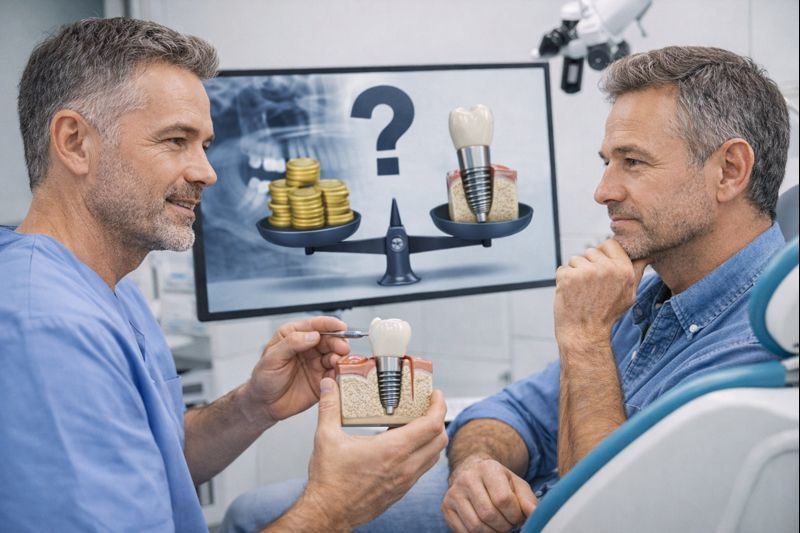
Because this isn’t a cosmetic tweak.
And it’s not just a dental bill.
It’s a decision that quietly affects eating habits, confidence, follow-up care, future expenses — and how much mental space a missing tooth keeps occupying.
Let’s slow this down.
Editorial context: why this question doesn’t have a clean yes-or-no
Dental implants sit at the intersection of:
- medical necessity
- lifestyle comfort
- long-term planning
That’s why blanket answers fail.
Some people genuinely benefit from implants.
Others would be better off choosing something simpler — even if implants look “ideal” on paper.
Worth the cost is not a universal metric.
It’s a personal calculation with hidden variables.
Who this is for
- You’re weighing are dental implants worth the cost beyond the sticker price
- You’re comparing implants to bridges or dentures
- You want durability without unrealistic expectations
- You’re planning years ahead, not just fixing today’s problem
Who this is NOT for
- You’re looking for the “best” or guaranteed solution
- You need immediate, emergency dental intervention
- You’re expecting implants to feel identical to natural teeth
- You’re not prepared for a multi-step process
Are dental implants worth the cost from a functional perspective?
Function is where implants make their strongest case.
Unlike bridges or removable dentures, implants:
- integrate into the jawbone
- don’t rely on neighboring teeth for support
- allow near-normal chewing force
That matters more than people expect.
Research suggests that tooth loss without proper load-bearing replacement may contribute to jawbone resorption over time, affecting facial structure and bite alignment. Implants are currently the only option designed to actively counter that process.
But function alone doesn’t settle the question.
The long-term cost question most comparisons miss
Here’s the part that rarely shows up in ads.
Short-term vs long-term thinking
Upfront, implants are expensive.
There’s no way around that.
But over 10–20 years:
- bridges may need replacement
- dentures often require relining or remaking
- adjacent teeth can suffer added stress
Implants don’t eliminate future costs — but they often shift them forward, instead of scattering them unpredictably.
That shift can be worth it.
Or not.
It depends on how stable your dental situation already is.
Comparing dental options side by side
| Dental implants | Bridges / dentures |
|---|---|
| Higher upfront cost | Lower initial expense |
| Designed for long-term stability | More frequent adjustments |
| No reliance on adjacent teeth | Neighboring teeth often involved |
| Requires surgery and healing | Less invasive initially |
This isn’t a hierarchy.
It’s a decision frame.
Are dental implants worth the cost emotionally?
This part is harder to quantify — and easier to dismiss.
But it matters.
Many patients report:
- reduced self-consciousness when speaking
- less planning around meals
- fewer daily reminders of tooth loss
According to population data on oral health quality-of-life measures, perceived confidence and comfort often improve after implant rehabilitation, even when objective chewing ability was already acceptable.
That doesn’t mean everyone feels the same improvement.
But for some, this is where implants quietly justify themselves.
The risks that make implants not worth the cost for some people
This is the section people skip — and shouldn’t.
Dental implants may not be worth the cost if:
- bone quality requires extensive grafting
- medical conditions complicate healing
- follow-up visits are difficult to maintain
- expectations lean toward “set it and forget it”
Implants demand patience.
Healing timelines matter.
Maintenance still exists.
If those realities don’t fit your life right now, the value equation changes.
Decision markers to pause on before committing
Ask yourself:
- Am I optimizing for longevity or immediacy?
- Can I commit to follow-up care?
- Would a less permanent solution reduce stress right now?
- How would I feel if this takes longer than expected?
None of these disqualify implants.
They clarify readiness.
What happens after the “yes” (and why this matters)
If you decide implants are worth the cost, the process usually unfolds in stages:
- diagnostics and planning
- implant placement
- healing and integration
- final restoration
- periodic monitoring
This is not a one-appointment fix.
Understanding that before committing is often what separates satisfaction from regret.
FAQ: are dental implants worth the cost?
Do implants last forever?
They are designed for long-term use, but longevity depends on care, health, and bite forces.
Are implants painful?
The procedure itself is usually well-managed; discomfort tends to appear during healing, not placement.
Are implants better than bridges?
Not automatically. The “better” option depends on anatomy, budget, and long-term goals.
Can I delay the decision?
Often yes — but delaying too long may affect bone structure and future options.
Final perspective (why this decision shouldn’t feel rushed)
Are dental implants worth the cost?
Sometimes the answer is yes —
not because they’re perfect,
but because they align with how someone wants to live long-term.
Other times, the smartest decision is to wait.
Or choose a different path altogether.
A good decision doesn’t eliminate doubt.
It just makes the trade-offs clearer.
Editorial team at BeautyHealth.top
Research-based consumer guides