
Dental implants cost by country: what the numbers really mean when you’re deciding
There’s a moment when most people stop asking “How much does a dental implant cost?”
And start asking something quieter.
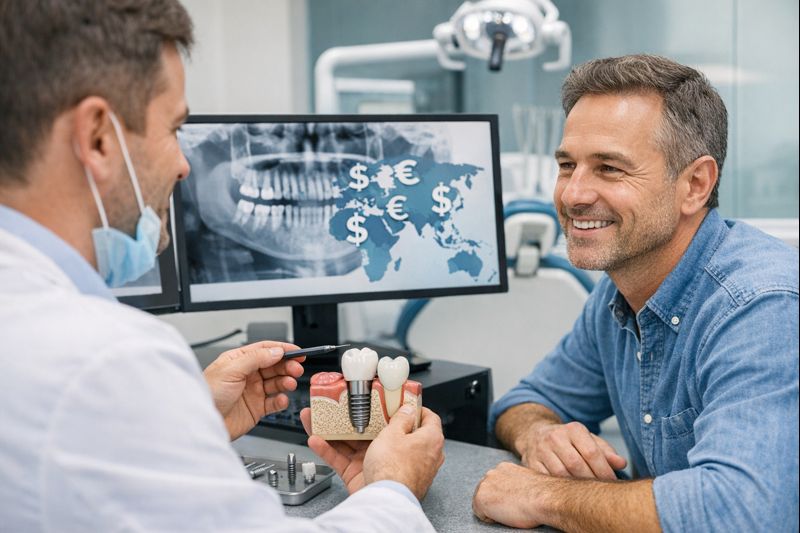
Why is the price so different from one country to another — and what am I actually paying for?
Because once you look past the headline numbers, dental implants cost by country stops being a price list.
It becomes a decision map.
Editorial context (why this comparison exists at all)
Dental implants sit in a strange space.
They’re medical.
They’re cosmetic.
And they’re long-term.
Which means people rarely compare them like they would flights or hotels.
Yet country-to-country price differences can be dramatic — sometimes 3× or 4× for what looks like “the same implant.”
Looks can be misleading.
Before we touch the numbers, it helps to slow down and understand why these gaps exist — and where they actually matter.
Who this is for
- You’re comparing dental implants cost by country because local pricing feels out of reach
- You’re considering treatment abroad but want clarity, not hype
- You care about long-term outcomes more than short-term savings
- You want to understand what changes when the country changes
Who this is NOT for
- You’re looking for the cheapest possible implant, regardless of follow-up
- You need emergency dental surgery immediately
- You’re expecting a single “best country” answer
- You want guarantees or fixed outcomes
Dental implants cost by country: typical ranges people see
Below are ballpark ranges for a single dental implant (implant + abutment + crown).
Not promotional prices.
Not “from $X” ads.
Just what patients usually encounter when they dig past the first quote.
| Country | Typical cost per implant |
|---|---|
| United States | $3,000 – $5,500 |
| United Kingdom | £2,500 – £4,000 |
| Germany | €2,000 – €3,500 |
| Spain | €1,200 – €2,500 |
| Poland | €900 – €1,800 |
| Hungary | €900 – €1,600 |
| Turkey | €700 – €1,500 |
| Mexico | $900 – $1,800 |
| Thailand | $1,000 – $2,200 |
At first glance, the conclusion feels obvious.
But this is where most comparisons quietly break.
Why dental implants cost by country varies so much
The implant itself rarely explains the difference.
In fact, many clinics worldwide use the same implant systems.
What changes is everything around it.
1. Clinical structure and regulation
Countries with higher costs usually have:
- stricter licensing and liability rules
- higher insurance overhead
- longer appointment times per patient
This doesn’t automatically mean better — but it does change risk distribution.
2. What’s included (and what isn’t)
Lower quotes often exclude:
- CT scans
- bone grafting
- temporary crowns
- post-op adjustments
The price looks lower — until it isn’t.
3. Follow-up reality
Dental implants are not a one-visit procedure.
They involve:
- healing phases
- bite adjustments
- monitoring osseointegration
Distance matters here more than people expect.
Dental tourism: where savings are real — and where they thin out
Countries like Spain, Poland, Hungary, Turkey, and Mexico are common in dental tourism conversations.
And yes — cost differences can be real.
But the decision hinges on one question:
Where will problems be handled if something doesn’t go as planned?
Research suggests that implant success rates are influenced not just by placement technique, but by post-operative monitoring and patient compliance, which becomes harder across borders.
That doesn’t disqualify treatment abroad.
It reframes it.
Comparing local vs abroad implants (decision snapshot)
| Staying local | Going abroad |
|---|---|
| Easier follow-up | Lower upfront cost |
| Higher initial price | Travel + recovery logistics |
| Familiar legal framework | Limited recourse if issues arise |
| Convenience over time | Requires planning discipline |
This isn’t about right or wrong.
It’s about trade-offs you can live with.
Dental implants cost by country: what people usually forget to ask
Here’s where decision markers quietly appear:
- Who handles complications months later?
- What happens if the crown needs adjustment?
- Are replacement parts available locally?
- Is the quoted implant system widely supported?
Studies have shown that patient satisfaction with implants correlates strongly with continuity of care, not just surgical success.
That’s rarely mentioned in pricing tables.
The “next step” most people skip
Instead of asking “Which country is cheapest?”, a more useful step is:
- Shortlist 2–3 countries
- Request fully itemized treatment plans
- Ask about post-placement support
- Clarify what happens if timelines change
Only then does the price comparison become real.
Not abstract.
Not misleading.
FAQ: dental implants cost by country
Is a cheaper country automatically riskier?
No. Risk depends on clinic standards, surgeon experience, and follow-up — not geography alone.
Are implants abroad lower quality?
Often no. Many use the same implant brands. The difference is in care structure.
Can local dentists fix implants done abroad?
Sometimes. But not all clinics accept external work, especially if systems differ.
Does insurance cover implants overseas?
Rarely. This varies widely and should be checked in advance.
Final thought (and why this decision rarely feels “finished”)
Dental implants are a long conversation with your future self.
Dental implants cost by country helps you enter that conversation informed —
but it doesn’t finish it for you.
And it shouldn’t.
The right choice is usually the one that still feels reasonable years later,
not just affordable today.
Editorial team at BeautyHealth.top
Research-based consumer guides