
Screwless Dental Implants: A Simpler, More Natural Approach to Tooth Replacement
Dental implants have been used successfully for decades, but not everyone is comfortable with the idea of tiny screws and multiple parts hidden beneath a crown. In recent years, a quieter shift has been happening in implant dentistry. More patients are asking about screwless implant options — systems designed to be simpler in structure and cleaner in appearance, while still offering reliable results.
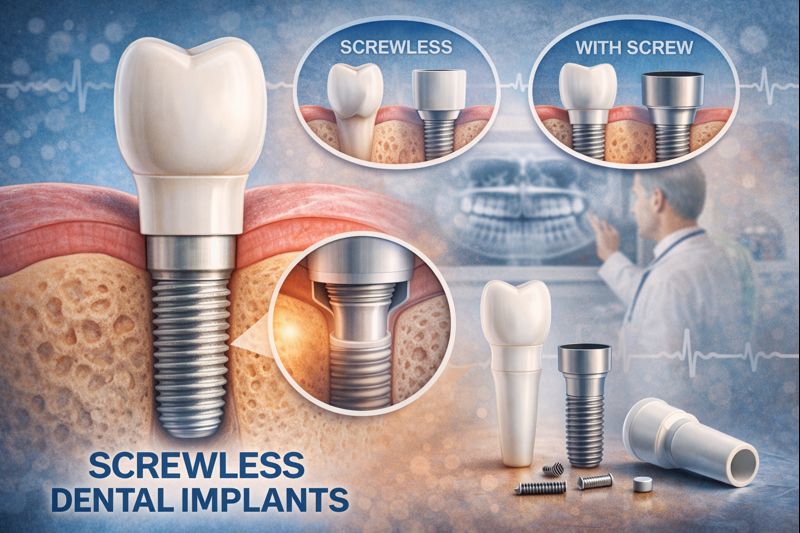
Instead of focusing on complex mechanics, screwless implant concepts aim to reduce components and rely on precision engineering and biological stability. For the right patient, this approach can feel more natural and less invasive.
What Does “Screwless” Really Mean?
Most traditional implants consist of two main parts: the implant placed in the bone and a separate abutment secured with a small screw. Screwless systems move away from this setup in a few different ways.
Some implants are manufactured as a single piece, meaning the implant and abutment are one continuous structure. There is no screw because there is nothing to attach. Other systems use a very precise friction-fit connection, where the abutment locks into the implant using a conical shape rather than a screw. There are also designs where the implant and abutment are secured, but the crown itself is held in place without a visible screw opening.
These options are typically made from titanium or zirconia. Titanium remains the most widely used material due to its long track record, while zirconia appeals to patients who prefer ceramic or metal-free solutions for esthetic or personal reasons.
Why Some Patients Are Drawn to Screwless Implants
For many people, the interest starts with appearance. Screw access holes in crowns can sometimes affect how natural a tooth looks or feels. Removing that feature can create a smoother, more tooth-like result.
Another consideration is simplicity. Fewer parts mean fewer connections that could loosen over time. Some patients also appreciate the idea of ceramic implants, especially in visible areas where gum color and translucency matter.
That said, screwless implants are not a universal solution. One-piece implants require extremely accurate placement because the angle cannot be changed later. If adjustments are needed down the road, options may be more limited. Friction-fit systems can also require special tools if the restoration needs to be removed. These are decisions that depend heavily on individual anatomy and bite forces.
How Screwless Implants Stay Secure
No matter how an implant is designed, long-term success depends on osseointegration — the process where bone bonds directly to the implant surface. Screwless systems simply handle the restorative connection differently.
With one-piece implants, the abutment is already exposed once the implant heals. The dentist shapes it carefully and places the final crown. Because everything is fixed, the implant must be positioned perfectly from the start.
Locking-taper systems rely on precision engineering. The abutment fits into the implant with a cone-shaped interface that creates strong retention through friction alone. Once seated, it remains stable under normal chewing forces.
Some designs still use a traditional abutment but avoid screws in the crown itself, using a friction cap instead. This eliminates visible screw channels and reduces the risk of excess cement near the gums.
Advantages and Limitations to Keep in Mind
Screwless implants can offer a cleaner look, fewer mechanical components, and in some cases a more natural soft-tissue response. Many clinicians also appreciate the reduced maintenance associated with certain friction-fit designs.
On the other hand, these systems demand precise planning and surgical accuracy. Retrieving or modifying restorations can be more complex, and not every clinical situation is suitable — especially larger bridges or full-arch cases where screw-retained frameworks are often preferred for long-term serviceability.
Regardless of the implant type, daily oral hygiene and regular professional check-ups remain essential for success.
Implant Options and Cost Overview
While treatment costs vary widely, a single dental implant in the United States commonly ranges from $3,500 to $6,500, depending on materials, location, and whether additional procedures are required. Ceramic or specialized screwless systems may be more expensive. Full-arch implant treatments often fall between $20,000 and $35,000 per arch.
These figures are general estimates and can change based on individual needs and provider expertise.
Final Thoughts
Screwless dental implants are not about replacing traditional systems, but about expanding the options available to patients. In the right situation, they can offer a streamlined, esthetic, and durable solution. In other cases, conventional screw-retained implants remain the most practical choice.
The best outcome always comes from a personalized treatment plan created by a qualified dental professional who understands both the technical and biological aspects of implant care.
Disclaimer: This article is intended for general informational purposes only and should not be considered medical advice. Always consult a licensed dental professional for diagnosis and treatment recommendations.